
How IT Penetration Testing Helps Prevent Data Breaches
Your business has security in place. Has any of it ever been tested against a real attack?
The security looks fine on paper, and everyone assumes it works. But unless those defenses are tested, you may not know how they’ll hold up against a real attack until an actual attacker shows up—and by then it’s too late to fix what didn’t hold.
The way around this is penetration testing, and it’s the closest thing your business has to a fire drill for a cyberattack. Penetration testing safely simulates attacks against your systems using many of the same techniques a criminal would, so you can find exploitable weaknesses before someone with bad intentions does.
But a pen test is a real investment, and you’ll make many important cybersecurity decisions based on what it tells you. So, it helps to approach this like any big purchase: know what you’re buying before you buy it.
This blog is your buying guide. You’ll walk away knowing:
What a real pen test actually does, and how it’s different from the security scans you may already pay for
The main types of testing, and which parts of your business each one checks
How often you should run one, and what the results tell you to fix first
What Is IT Penetration Testing?
The simplest way to define penetration testing is as an authorized simulated attack on your computer systems. You give a team of security experts permission to break in, and they attack your defenses using the same tools and tricks a real hacker would. The goal is to find the weak spots in your system’s security before someone with bad intentions does.
Essentially, a penetration test is a controlled attack you actually want to happen.
Anyone can confirm your firewall is switched on and your antivirus is running. IT penetration testing asks a harder question: if someone actually tried to get past those security features, would they succeed?
You don’t get a guess. You get a tested answer.
How Does Penetration Testing Help Prevent Data Breaches?
Many data breaches happen because attackers find security weaknesses that haven’t been identified or fixed. Here’s how penetration testing helps you find those gaps:
It finds the security weaknesses attackers actually use
A pen tester attempts to exploit vulnerabilities and chain weaknesses together the way a criminal would to see how far into your network they can get.
Maybe a single weak login lets them gain unauthorized access to one machine, and from there they reach the server holding your sensitive data. That path is exactly how a breach happens, and now you’ve seen it before an attacker walks it.
It shows you what’s actually at risk
A good test doesn’t stop at “we got in.” It shows you what an attacker could reach once inside:
which sensitive information is exposed
which systems they could take over
how much damage a single weak point could cause
That turns a vague worry into a specific, fixable list.
It tells you whether you’d even notice
Penetration testing launches simulated attacks against your systems to test both your security controls and your response capabilities. If testers can move through your network without tripping an alarm, that’s something you need to know, because a real attacker may be able to do the same.
This is also where red team and blue team exercises can take testing further. Instead of only identifying whether an attacker could get in, these exercises can test how effectively your organization detects and responds to a simulated attack.
A red team exercise goes beyond a typical penetration test by testing how well your overall defenses stand up to a realistic attack. Depending on your security needs, RTS can provide or coordinate penetration testing and red team and blue team exercises to help you understand not only where you’re vulnerable, but how effectively your organization could detect and respond to an attack.
The result is a prioritized list of what to fix first, ranked by how much damage each gap could do.
What Is the Difference Between Penetration Testing and Vulnerability Scanning?
Although these terms may seem related, these two tests are very different. This confusion is the reason some businesses pay pen test prices for something much cheaper.
A vulnerability scan is automated
A vulnerability assessment typically uses automated scanning tools to sweep your systems, compare what they find against known security vulnerabilities, and produce a report of anything that looks suspect. It’s fast, it’s cheap, and it’s genuinely useful for identifying vulnerabilities you didn’t know existed.
The catch is that a vulnerability scanner mainly identifies what might be a problem rather than proving what an attacker could actually exploit. It doesn’t tell you the full story of what an attacker could actually do with those weaknesses, so you can end up with a long list of potential vulnerabilities without knowing which ones matter most.
A pen test goes beyond identifying vulnerabilities
Penetration testing goes beyond simply identifying possible security flaws. It attempts to determine whether those weaknesses can actually be exploited and what an attacker could potentially reach if they succeed.
Penetration testing can be performed in different ways. Traditional penetration testing relies heavily on security professionals manually probing and exploiting systems, while automated virtual penetration testing uses specialized technology to continuously or repeatedly simulate attack techniques and validate exploitable weaknesses. Both go further than a basic vulnerability scan by helping determine which weaknesses create a real path into your environment.
Why this matters when you’re buying
Both are legitimate security tests, and most businesses should run both. They just do different jobs:
Vulnerability scans: run on a regular schedule to catch new security issues as they appear, and feed your broader risk assessments
Pen tests: go deeper, cost more, and happen less often
Order matters too. The sequence that gets you the most for your money:
Scan first to surface the obvious problems
Fix what it finds
Then pen test to see what’s still standing
Paying skilled testers to discover an unpatched server is an expensive way to learn something a scanner would have told you for a fraction of the cost.
If you’re not sure where your business sits in that sequence, our guide to which security assessment your business needs walks through all four types and when each one makes sense.
The other thing to watch is a vendor selling you the first and pricing it like the second. If you’re paying for penetration testing, ask exactly what the service includes. Is it simply identifying possible vulnerabilities, or does it attempt to validate whether those weaknesses can actually be exploited? Is the testing automated, manually performed by security professionals, or a combination of both? And most importantly, will the results tell you what creates the greatest risk to your business and what you should fix first?
What Are the Main Types of Penetration Testing?
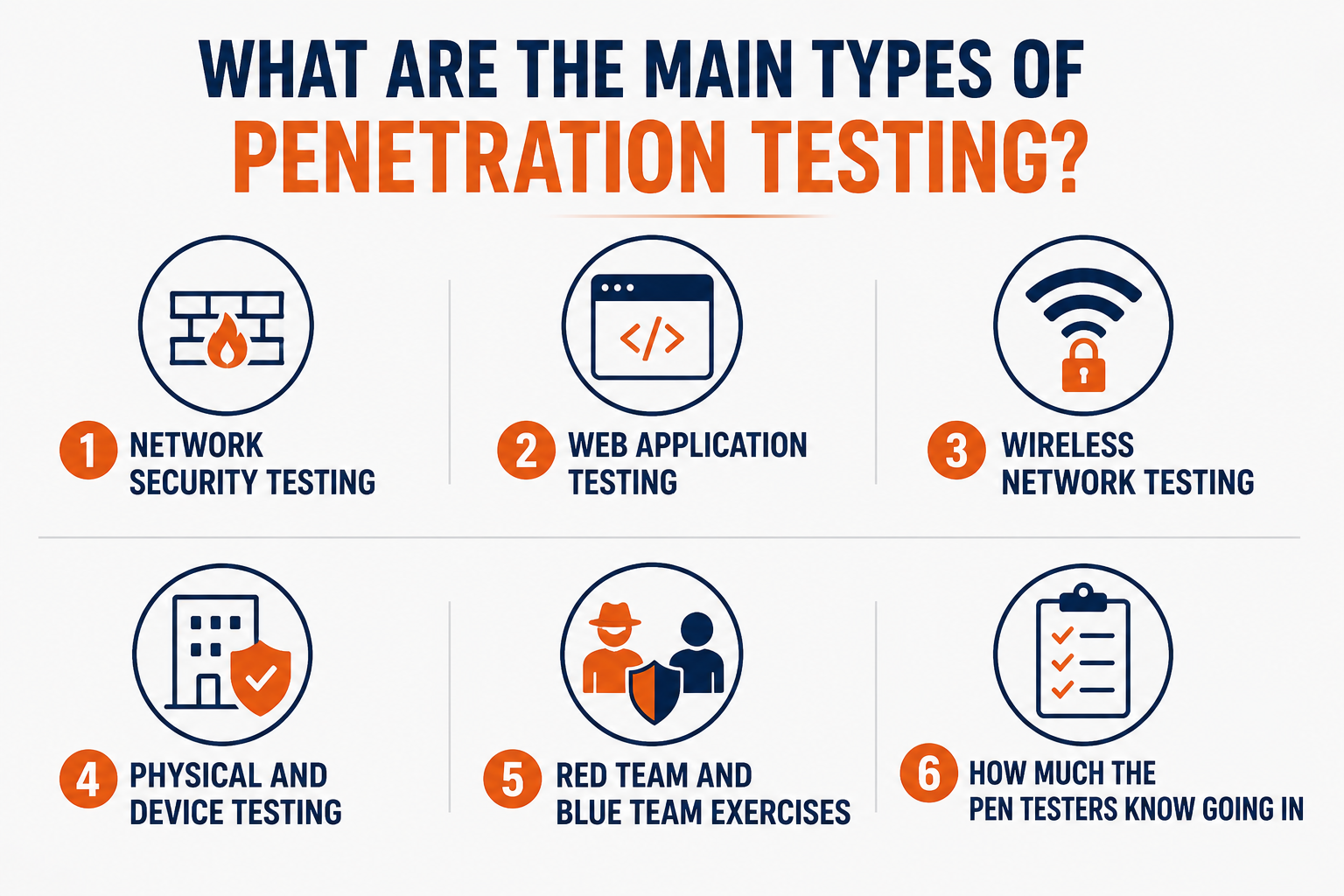
“Pen test” isn’t one product. It’s a category, and the type you buy determines what actually gets checked. This is where too-narrow tests come from: a business pays for one slice of coverage and assumes the whole IT system got looked at.
Here are the main types of penetration testing and what each one covers.
Network security testing
The most common starting point, and it splits in two directions.
External test: penetration testers attack from the outside, like a stranger on the internet. They run a port scanner against anything facing the public, then probe your company’s firewall, your email server, and your remote access setup for a way in.
Internal test: testers start inside your internal network, simulating someone who already has a foot in the door. That could be a disgruntled employee, a contractor, or an attacker who slipped past you through a phishing email.
Internal tests matter more than most owners expect, because insider threats and stolen logins walk right around your perimeter. If your whole defense is a strong outer wall, an internal test shows what happens once someone is past it and how far your access controls really slow them down.
Web application testing
If your business runs a customer portal, an online store, or any web app that touches customer data, this one applies to you. Testers go after your web applications and web servers hunting for exploitable vulnerabilities like SQL injection and cross-site scripting, which can allow an attacker to access or manipulate data.
These are some of the most common security holes in any target system, and they’re rarely visible from the outside until someone tries.
Wireless network testing
Your office Wi-Fi is a door into your systems. Testers check whether someone sitting in the parking lot could join your wireless networks, capture network traffic, or hop onto the guest network and gain access to something they shouldn’t.
Physical and device testing
Less technical, often more effective. Can someone walk into your office, plug into an open jack, and reach the network? What happens to your data when a lost laptop or one of your mobile devices ends up in the wrong hands? These checks measure the security measures around your building and your equipment, not just your software.
Red team and blue team exercises
A red team exercise takes the attacker mindset further. Instead of testing one defined part of your environment, the red team looks for different ways around your system’s defenses to accomplish a larger objective, such as gaining access to sensitive information or critical systems.
The blue team plays defense. Its job is to detect the simulated attack, investigate what is happening, contain it, and respond appropriately.
Used together, red and blue team exercises can answer a broader question than a traditional penetration test: If someone seriously tried to attack your business, how well would your technology, security controls, and response processes work together to stop them?
Not every small or mid-sized business needs this level of testing. The right approach depends on your risks, regulatory requirements, environment, and what you’re trying to validate.
How much the pen testers know going in
Separate from what gets tested is how much information you hand over about the target environment.
Full knowledge: testers get network diagrams, credentials, and documentation. Fast and thorough.
Partial knowledge: testers get some information, which mirrors real-world attacks by someone who has done their homework or gotten a small foothold.
Blind: testers receive little or no information about the environment in advance. This can more closely simulate an external attacker but typically requires more time and reconnaissance.
Most businesses don’t necessarily need every type of penetration test at once. What you do need is a clear answer on which types you’re buying, so the test can uncover vulnerabilities everywhere that matters instead of one narrow slice.
How Does the Penetration Testing Process Work?
Penetration testing generally follows a repeatable sequence, although the exact process varies depending on whether the testing is automated, manually performed, or combines both approaches. Knowing the steps helps you tell a serious engagement from a rushed one.
1. Scoping and rules of engagement
Before anyone touches anything, you and the testing team agree on what’s in bounds. Which systems, which offices, which hours, and what happens if they find something critical mid-test. This is also where you set the knowledge level and confirm nobody’s going to knock your order system offline on a Monday morning.
Vague scoping is where narrow tests come from. Get this part in writing.
2. Reconnaissance and scanning
The penetration testing team gathers information about your target organization the same way an attacker would. Public information, employee information available online, exposed systems, and other details an attacker could discover. Then they scan to map what’s actually running on your systems and where the soft spots might be.
3. Gaining access
Now they try to break in. The testing attempts to exploit identified vulnerabilities, combine smaller weaknesses, and determine whether they create a real path into systems or sensitive information. In manually performed penetration testing, human judgment can also uncover combinations of weaknesses that automated testing may not identify on its own.
4. Maintaining access
Testers see whether they can hold their position, move to other systems, and reach your most valuable data without your security team noticing.
Maintaining access helps show how much additional risk an attacker could create by remaining inside your environment, moving between systems, and reaching sensitive data.
5. The penetration test report
Everything ends in the penetration test report, and this is the part you’re really buying. A strong test report tells you:
What they found
How they exploited it
What data was reachable
What to fix first, ranked by risk
Ask to see a sample report before you hire anyone. If it reads like a printout with no plain-language explanation of what to do next, you’ll pay for the test and change nothing.
6. Remediation and retest
You fix what the report found, then a retest confirms the fixes actually worked. Good security processes treat this step as part of the job, not an optional add-on.
How Often Should Penetration Testing Be Performed?
For many businesses, annual penetration testing is a practical baseline, with additional testing after significant changes or when required by a regulation, contract, or security framework. Your systems change faster than the calendar does, and a test only reflects the setup it was run against.
Run one at least annually
For many businesses, a yearly test is a reasonable baseline. It catches the drift that builds up over twelve months of new software, new users, and small changes nobody flagged as a security risk.
Run one after anything significant changes
A test from last spring says nothing about the setup you have today. Book another one after you:
Migrate to a new server, cloud platform, or major application
Open a new office or add a remote access setup
Roll out a customer-facing portal or e-commerce site
Make a major change to your network or access controls
Run one as often as your regulations require
Penetration testing can also support regulatory compliance. Some regulations, industry standards, contracts, and security frameworks require or encourage regular security testing, and some specifically call for penetration testing:
PCI DSS: requires penetration testing at least annually and after significant changes for organizations that fall within the applicable penetration-testing requirements.
HIPAA: requires regulated organizations to assess risks and vulnerabilities and periodically evaluate their security safeguards. Penetration testing can be part of that process, but the current HIPAA Security Rule does not specifically require an annual penetration test.
GDPR: requires your organization to regularly test, assess, and evaluate the effectiveness of your technical and organizational security measures if you handle data of EU residents.
Industry frameworks and contractual requirements: defense contractors, financial firms, and businesses serving security-conscious clients may face additional testing requirements or expectations.
Across many security frameworks, regular testing and validation are treated as important parts of an effective cybersecurity program.
This isn’t only a vendor recommendation, either. In 2021, the White House urged U.S. companies to establish a penetration testing schedule as part of a short list of steps to defend against ransomware, and federal guidance has pointed the same direction ever since.
Check what your cyber insurance requires
Insurers increasingly ask whether you’ve tested. If your policy or application specifies a testing requirement or cadence, failing to meet it could create problems when you need coverage most.
Whoever owns security at your business should map these requirements before setting a schedule, because meeting a requirement after the fact costs more than meeting it on time.
What Are the Business Benefits of Regular Penetration Testing?
A single security assessment tells you where you stand today. Testing on a regular cycle changes how your business operates, and the payoff shows up in places that have nothing to do with IT.
You spend your security budget on what matters
Without testing, security spending is guesswork. You only buy tools because a vendor recommended them or a competitor has them. A test replaces some of that guesswork with evidence and helps show you which fixes could have the greatest impact on your security posture, so you can prioritize your security spending.
You can answer the questions clients and insurers ask
Enterprise clients send security questionnaires. Insurers ask what you’ve tested. Auditors want proof of your data protection practices. Businesses that test regularly are better prepared to answer these requests, while businesses without current testing and documentation may find themselves scrambling when a client, insurer, or auditor asks and may lose a deal.
You catch problems while they’re still cheap
The financial case is straightforward. IBM’s 2025 Cost of a Data Breach Report puts the global average cost of a data breach at $4.44 million and the average U.S. breach at $10.22 million. The cost of a penetration test can be small compared with the potential financial impact of a serious breach.
A weakness found during a test can often be addressed in a few hours. The same weakness found by a cybercriminal costs you downtime, legal fees, notification requirements, and customers who don’t come back.
You stop guessing
Regular testing lets you validate defenses against a realistic, controlled attempt to break them, and gaining that assurance is worth more than any single tool you could buy.
At RTS, we help small and mid-sized businesses determine the right level of security testing for their environment, from automated virtual penetration testing to more comprehensive testing and red team exercises when appropriate.
But finding a vulnerability is only useful if you know what to do about it. We help scope and coordinate the testing, walk you through the findings in plain language, prioritize what creates the greatest risk, address the vulnerabilities that are uncovered, and verify that the problems have been resolved.
The goal isn’t simply to hand you a report showing where your security failed. It’s to help you strengthen those weak points before a real attacker finds them.
If you’re looking to better understand your security vulnerabilities, reach out to Lenny Giller at lenny@reliabletechnology.co, and we’ll walk you through what a real test would look like for your business.